Dental Emergency Survival: Handling Tooth Pain Without a Dentist
Dental pain is one of the most excruciating experiences the human body can produce. Here's how to manage tooth emergencies when professional help isn't available, and how to tell when you're facing a true life-threatening situation.
Dental Emergency Survival: Handling Tooth Pain Without a Dentist
It's 2 AM, and the throbbing in your molar has gone from annoying to unbearable. You can't sleep, can't think, and the earliest dental appointment is three days away. Dental pain is one of the most excruciating experiences the human body can produce, and it doesn't care about office hours, holidays, or whether you're stuck in a disaster zone. Here's how to manage tooth emergencies when professional help isn't available, and how to tell when you're facing a true life-threatening situation.
Why Dental Pain Is Different (and Dangerous)
Tooth pain isn't like a headache or sore muscle. Your teeth contain nerves encased in hard enamel with nowhere to go when infection or inflammation strikes. The pressure builds inside the tooth like a tiny pressure cooker, creating pain that can make grown adults cry. [1]
But the real danger isn't the pain itself. It's what the pain signals: infection. A tooth abscess is a pocket of bacteria that can spread to your jaw, neck, brain, or bloodstream. Before modern antibiotics, dental infections killed people regularly. They still do when left untreated. [2]
The Five Dental Emergencies You Need to Recognize
Not all tooth problems are equal. Some can wait; others are medical emergencies.
1. Tooth Abscess (Infection)
Symptoms:
- Severe, throbbing pain that radiates to jaw, ear, or neck
- Swelling in face, cheek, or lymph nodes
- Fever and general feeling of illness
- Foul taste in mouth (pus draining)
- Tooth feels "tall" or loose
Danger level: HIGH. This is an infection that can spread to your brain or heart.
Timeline: Without treatment, abscesses can become life-threatening in 3 to 7 days.
2. Knocked-Out Tooth (Avulsion)
Symptoms:
- Tooth completely out of socket
- Bleeding from empty socket
- Visible root of tooth
Danger level: MODERATE. Not life-threatening, but tooth can be saved if you act in the first 30 minutes.
Timeline: After 1 hour out of the socket, tooth survival rate drops to nearly zero. [3]
3. Cracked or Broken Tooth
Symptoms:
- Sharp pain when biting
- Sensitivity to hot/cold
- Visible crack or missing piece
- Rough edge cutting tongue or cheek
Danger level: LOW to MODERATE. Depends on whether crack reaches the nerve.
Timeline: Can wait days to weeks, but exposed nerve needs urgent care.
4. Lost Filling or Crown
Symptoms:
- Sudden sensitivity
- Hole where filling was
- Crown came off (you're holding it)
- Food packing into cavity
Danger level: LOW. Uncomfortable but not dangerous short-term.
Timeline: Can wait 1 to 2 weeks, but exposed tooth is vulnerable to further damage.
5. Dry Socket (After Extraction)
Symptoms:
- Severe pain 2 to 4 days after tooth removal
- Empty socket (blood clot fell out)
- Visible bone in socket
- Bad breath and foul taste
Danger level: MODERATE. Extremely painful but not life-threatening.
Timeline: Needs treatment within 24 to 48 hours to prevent worsening pain.
Emergency Pain Management: What Actually Works
Over-the-counter pain relievers are your first line of defense. Here's how to use them effectively.
The Alternating Ibuprofen-Acetaminophen Protocol
This combination is as effective as many prescription painkillers and is safe for most adults. [4]
Dosage schedule:
- Hour 0: Take 600mg ibuprofen (three 200mg tablets)
- Hour 3: Take 1000mg acetaminophen (two 500mg tablets)
- Hour 6: Take 600mg ibuprofen
- Hour 9: Take 1000mg acetaminophen
- Repeat cycle
Why this works: The two drugs work through different mechanisms and don't interfere with each other. Alternating keeps pain relief constant without exceeding safe doses of either drug.
Maximum duration: 3 to 5 days. If you need pain relief longer than this, you need a dentist or doctor.
Do not use if: You have kidney disease, liver disease, stomach ulcers, or are pregnant. Consult dosing guidelines for children.
Topical Treatments That Help
Clove oil (eugenol): The active ingredient in many dental pain products. Dentists actually use this.
- Apply 1 to 2 drops on a cotton ball
- Place directly on painful tooth (avoid gums; it burns)
- Provides 1 to 2 hours of numbing relief
- Can reapply every 2 to 3 hours [5]
Benzocaine gel (Orajel, Anbesol): Over-the-counter numbing gel.
- Apply small amount to painful area
- Works in 30 seconds, lasts 15 to 20 minutes
- Good for temporary relief while waiting for oral pain meds to kick in
Salt water rinse: Reduces inflammation and cleans the area.
- Mix 1/2 teaspoon salt in 8 oz warm water
- Swish for 30 seconds, spit out
- Repeat every 2 to 3 hours
Ice pack: Reduces swelling and numbs pain.
- Apply to outside of cheek for 15 minutes
- Remove for 15 minutes
- Repeat cycle
Treating a Tooth Abscess Without Antibiotics
An abscess is an infection. Without antibiotics, your goal is to help your body fight it while preventing spread.
Drainage Is Critical
If the abscess forms a visible bump on your gum (looks like a pimple), draining it provides immediate pressure relief.
How to drain safely:
- Sterilize a needle with rubbing alcohol or flame
- Rinse your mouth with salt water
- Gently pierce the bump (it should release pus immediately)
- Let it drain completely
- Rinse with salt water every 2 hours
Warning: This is temporary relief only. The infection is still there and will refill. You need antibiotics.
Natural Antibacterial Rinses
While not as effective as prescription antibiotics, these can slow bacterial growth:
Hydrogen peroxide rinse:
- Mix equal parts 3% hydrogen peroxide and water
- Swish for 30 seconds, spit out (do not swallow)
- Use 3 to 4 times daily
Garlic: Contains allicin, a natural antibacterial compound.
- Crush a fresh garlic clove into paste
- Apply directly to tooth for 5 to 10 minutes
- Rinse with salt water
- Repeat 2 to 3 times daily [6]
When You Absolutely Need Antibiotics
Some situations are beyond home treatment. Seek medical care immediately if you have:
- Swelling that closes your eye or makes it hard to swallow
- Fever over 101°F (38.3°C)
- Difficulty breathing
- Swelling spreading down your neck
- Severe pain that doesn't respond to maximum-dose pain relievers
These are signs the infection is spreading. This is a medical emergency. Go to an emergency room if you can't reach a dentist. [2]
Saving a Knocked-Out Tooth
You have a 30-minute window to save a permanent tooth. After that, the cells on the root die and the tooth won't reattach. [3]
Immediate steps:
- Find the tooth and pick it up by the crown (white part), never the root
- Rinse gently with milk or saline (not tap water; it kills root cells)
- Reinsert immediately if possible:
- Face a mirror
- Gently push tooth back into socket
- Bite down on clean cloth to hold it in place
- If you can't reinsert, store it properly:
- Best: Place in cup of cold milk
- Second best: Hold between cheek and gum
- Last resort: Cup of saliva or saline
- Get to a dentist within 30 minutes
Never: Let the tooth dry out, scrub the root, or store in tap water.
Temporary Filling for Lost Fillings or Crowns
Exposed tooth structure is sensitive and vulnerable. Temporary filling material protects it until you can see a dentist.
Dental cement (Dentemp, DenTek): Available at any pharmacy for $5 to $8.
- Clean and dry the cavity
- Roll a small ball of cement
- Press into cavity
- Bite down gently to shape
- Remove excess with toothpick
- Avoid eating on that side for 1 hour
For lost crowns:
- Clean inside of crown
- Fill with dental cement
- Press back onto tooth
- Bite down to seat properly
- Wipe away excess
Emergency alternative: Sugar-free gum can work for a few hours if you have no other option. It won't last, but it protects the exposed area temporarily.
Treating Dry Socket
Dry socket happens when the blood clot that should protect the extraction site falls out, leaving raw bone exposed. The pain is intense.
Home treatment:
- Rinse gently with salt water to remove debris (don't swish hard)
- Pack the socket with a small piece of gauze soaked in clove oil
- Replace packing every 4 to 6 hours
- Take maximum-dose pain relievers (alternating protocol above)
- Avoid: Smoking, straws, spitting (creates suction that prevents clot formation)
This is a temporary measure. You need a dentist to properly clean and pack the socket. The pain won't fully resolve without professional treatment.
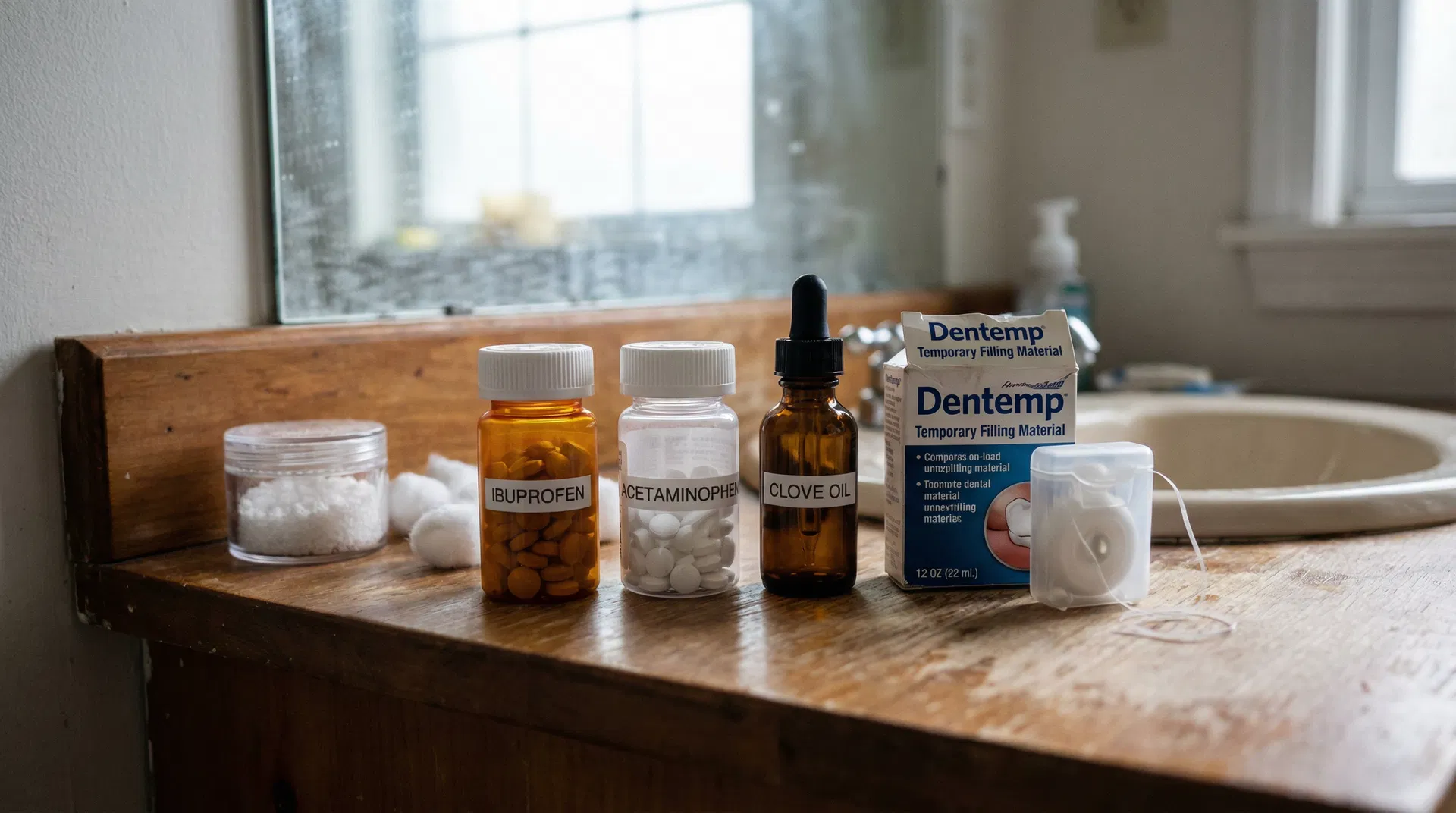
The Survival Dental Kit: $15
Keep these items in your emergency supplies:
| Item | Cost | Purpose |
|---|---|---|
| Ibuprofen (200mg, 50-count) | $3 | Pain relief |
| Acetaminophen (500mg, 50-count) | $3 | Pain relief |
| Clove oil (small bottle) | $4 | Topical numbing |
| Temporary filling material (Dentemp) | $6 | Protect exposed teeth |
| Dental floss | $2 | Remove trapped food |
| Salt (for rinses) | $1 | Reduce inflammation |
Total: $19
Add a small dental mirror ($3) if you want to see what you're doing.
Prevention: The Best Emergency Treatment
Most dental emergencies are preventable with basic care:
- Brush twice daily with fluoride toothpaste (prevents decay)
- Floss daily (prevents gum disease and abscesses)
- Avoid chewing ice, hard candy, popcorn kernels (prevents cracks)
- Wear a mouthguard for contact sports (prevents knocked-out teeth)
- Address small problems early (small cavities don't become abscesses)
In a long-term survival situation where dentists don't exist, prevention becomes critical. A toothbrush and fluoride toothpaste are as important as food and water.
When to Go to the Emergency Room (Not the Dentist)
Most dental problems aren't ER-worthy, but these are:
- Facial swelling that affects breathing or swallowing
- Uncontrolled bleeding that doesn't stop after 15 minutes of pressure
- Jaw fracture (from trauma; jaw won't close properly)
- Severe infection with fever, confusion, or rapid heartbeat (signs of sepsis)
Emergency rooms can't fix your tooth, but they can treat life-threatening infections and provide IV antibiotics and strong pain medication.
The Bottom Line
Dental emergencies are agonizing and potentially dangerous, but most can be managed at home for days to weeks if you know what you're doing. The key is understanding the difference between pain (which you can treat) and infection (which you can slow but not cure without antibiotics).
Stock your emergency kit with pain relievers, clove oil, and temporary filling material. Learn to recognize the signs of spreading infection. Know how to save a knocked-out tooth in the critical first 30 minutes. These skills bridge the gap between "my tooth hurts" and "I need an ER."
But here's the hard truth: home treatment is temporary. Dental problems don't heal themselves. An abscess will come back. A cracked tooth will get worse. A lost filling will turn into a bigger cavity. Use these techniques to survive until you can get professional care, not as a permanent solution.
Take care of your teeth. In a world without dentists, they're irreplaceable.
Sources and References
[1] American Dental Association (ADA). "Toothache and Infections." Accessed February 2026. https://www.ada.org/resources/research/science-and-research-institute/oral-health-topics/toothaches
[2] Mayo Clinic. "Tooth Abscess: Symptoms & Causes." Accessed February 2026. https://www.mayoclinic.org/diseases-conditions/tooth-abscess/symptoms-causes/syc-20350901
[3] American Association of Endodontists. "Traumatic Dental Injuries." Accessed February 2026. https://www.aae.org/patients/dental-symptoms/traumatic-dental-injuries/
[4] Journal of the American Dental Association. "Ibuprofen and Acetaminophen for Dental Pain." Accessed February 2026. https://jada.ada.org/article/S0002-8177(14)00001-1/fulltext
[5] National Center for Biotechnology Information. "Clove Oil (Eugenol) for Dental Pain." Accessed February 2026. https://www.ncbi.nlm.nih.gov/pmc/articles/PMC4054083/
[6] Journal of Medicinal Food. "Antimicrobial Properties of Garlic." Accessed February 2026. https://www.liebertpub.com/doi/10.1089/jmf.2018.0003
No comments yet. Be the first to share your thoughts!
Related Articles

Identify and use 10 common medicinal plants for minor injuries and ailments. Complete with identification photos and practical uses.
Contaminated water causes more deaths worldwide than war. When medical care isn't available, knowing how to recognize and treat waterborne illness can mean the difference between recovery and a life-threatening crisis.
Most household first aid kits are useless in real emergencies. Here's how to build a genuinely life-saving first aid kit for $20 that prioritizes what actually matters: stopping bleeding, preventing infection, and stabilizing injuries.