
**The water main just broke, and your taps are bone dry.** While your neighbors panic, you remember: there's 30-50 gallons of clean, drinkable water sitting in your basement right now. Your hot water heater is an emergency reservoir most people forget exists.
Emergency Water from Your Hot Water Heater: Step-by-Step Guide
In a widespread emergency where tap water is no longer safe or available, your home contains a hidden reservoir of 30 to 80 gallons of potable water: your hot water heater. [1] This often-overlooked resource can provide enough water for a family of four for several days, but you need to know how to access it safely.
This guide provides a clear, step-by-step process for draining your hot water heater to get emergency drinking water.
Is the Water Safe to Drink?
For most modern homes, the answer is yes, the water in your hot water heater is generally safe to drink in an emergency. It is the same water that comes out of your cold tap, just heated. [2]
However, there are a few important caveats:
- If your tap water was contaminated BEFORE the outage, the water in your tank will also be contaminated. The heat is not enough to kill all microorganisms.
- Very old water heaters (pre-2000s) may have sediment buildup or parts that are not considered food-grade. If you have an old or poorly maintained tank, it is best to purify the water after draining it.
- Tankless water heaters do not store water and cannot be used as an emergency source.
Safety First: The U.S. Environmental Protection Agency (EPA) advises against drinking or cooking with water from the hot water tap during normal times, as hot water can dissolve contaminants like lead from older pipes more readily than cold water. [3] However, in a true emergency where this is your only source of water, the risk is minimal compared to the risk of dehydration.
What You Will Need
Before you begin, gather these simple tools:
- Hose: A standard garden hose is perfect.
- Bucket or Large Pot: To collect the water.
- Pliers or a Wrench (optional): May be needed to open a stiff drain valve.
- A Helper (optional but recommended): To help with opening faucets on other floors.
Step-by-Step Guide to Draining Your Water Heater
Follow these steps carefully to ensure you get clean water without damaging your water heater.
Step 1: Turn Off the Power and Water Supply
This is the most critical step for your safety. Do not skip this.
- For an Electric Water Heater: Go to your circuit breaker box and turn off the breaker that controls the water heater. It should be clearly labeled.
- For a Gas Water Heater: Find the gas shutoff valve on the pipe leading to the tank. The valve handle should be perpendicular to the pipe when off. Also, turn the thermostat dial on the tank to the "OFF" position. [4]
Next, shut off the cold water supply to the tank. There will be a valve on the cold water pipe entering the top of the water heater. Turn it clockwise until it is fully closed.
(Image credit: Regional Water Providers Consortium)

Step 2: Open a Hot Water Faucet
Go to a sink in your house (preferably on an upper floor) and turn on the hot water faucet. This will release the vacuum in the pipes and allow air to enter the system, which is necessary for the water to drain from the tank. [5] You may hear some gurgling noises; this is normal.
Step 3: Connect the Hose to the Drain Valve
At the bottom of your water heater, you will find a drain valve (also called a spigot or boiler drain). Attach your garden hose to this valve and place the other end in your bucket or pot.
Step 4: Open the Drain Valve
Slowly turn the handle on the drain valve counter-clockwise to open it. Water should begin to flow out of the hose. If the valve is stiff, you may need to use pliers to get it started.
Important: The first few gallons of water may contain sediment from the bottom of the tank. It is a good idea to discard this initial water and start collecting once the water runs clear.
Step 5: Collect the Water
Continue draining the water into your containers until the tank is empty or you have collected as much as you need. A standard 40-gallon tank can take 10-15 minutes to drain completely.
Step 6: Closing Up
Once you are finished, close the drain valve tightly. You can leave the water supply and power off until municipal services are restored.
How to Purify the Water (If Needed)
If you have any concerns about the safety of the water, it is always best to purify it before drinking. Here are the simplest methods:
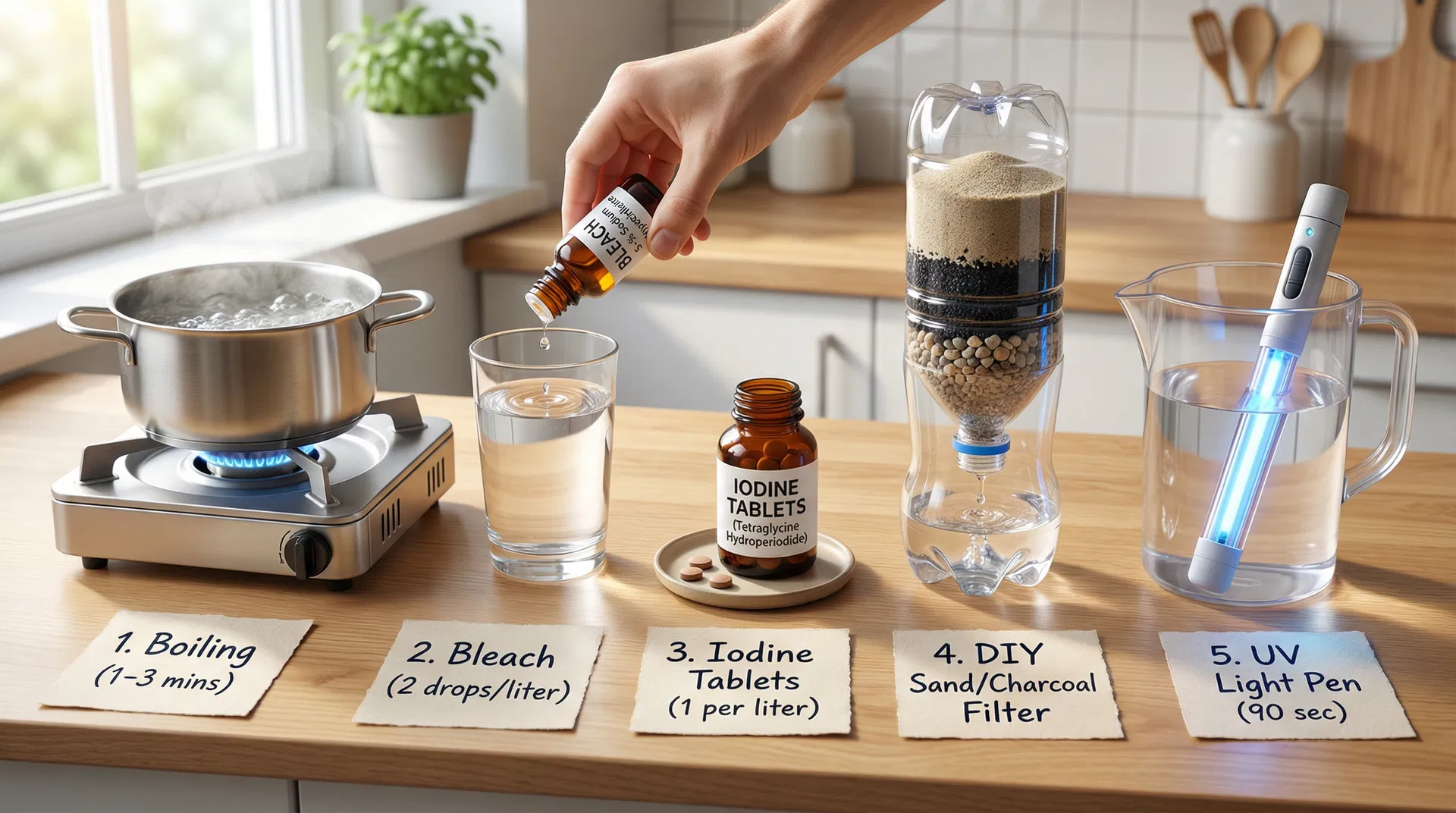
- Boiling: Bring the water to a rolling boil for at least one full minute. This will kill most bacteria, viruses, and protozoa. [6]
- Bleach: Add 8 drops (1/8 teaspoon) of plain, unscented household bleach per gallon of water. Stir and let it stand for 30 minutes before drinking. [6]
The Bottom Line
Your hot water heater is a valuable emergency resource that is often overlooked. By learning these simple steps, you can ensure your family has access to a significant supply of clean drinking water during a crisis. Take a few minutes to locate the shutoff valves on your own water heater today so you are prepared before an emergency strikes.
References
[1] American Red Cross. "Emergency Water Sources." Accessed December 17, 2025. https://www.redcross.org/get-help/how-to-prepare-for-emergencies/survival-kit-supplies/emergency-water-sources.html [2] Quora. "Is it safe to drink the water from your household hot water heater?" Accessed December 17, 2025. https://www.quora.com/Is-it-safe-to-drink-the-water-from-your-household-hot-water-heater-Does-it-matter-if-its-gas-or-electric [3] U.S. Environmental Protection Agency (EPA). "Why can't I use hot water from the tap for drinking, cooking, or making baby formula?" Accessed December 17, 2025. https://www.epa.gov/lead/why-cant-i-use-hot-water-tap-drinking-cooking-or-making-baby-formula [4] WikiHow. "How to Get Emergency Drinking Water from a Water Heater." Accessed December 17, 2025. https://www.wikihow.com/Get-Emergency-Drinking-Water-from-a-Water-Heater [5] Regional Water Providers Consortium. "How to access water from your water heater during an emergency." Accessed December 17, 2025. https://www.regionalh2o.org/sites/default/files/images/Water_Heater_Hanger_English.pdf [6] Centers for Disease Control and Prevention (CDC). "Making Water Safe in an Emergency." Accessed December 17, 2025. https://www.cdc.gov/healthywater/emergency/making-water-safe.html
No comments yet. Be the first to share your thoughts!
Related Articles
Learn 5 budget-friendly methods to purify water using everyday items under $5. From boiling to DIY filters, master emergency water treatment.
Build a DIY gravity water filter from hardware store parts for $15-25. Filter murky water using two buckets and ceramic filter candles.

Learn how to safely store emergency water using free and nearly-free containers you already have.