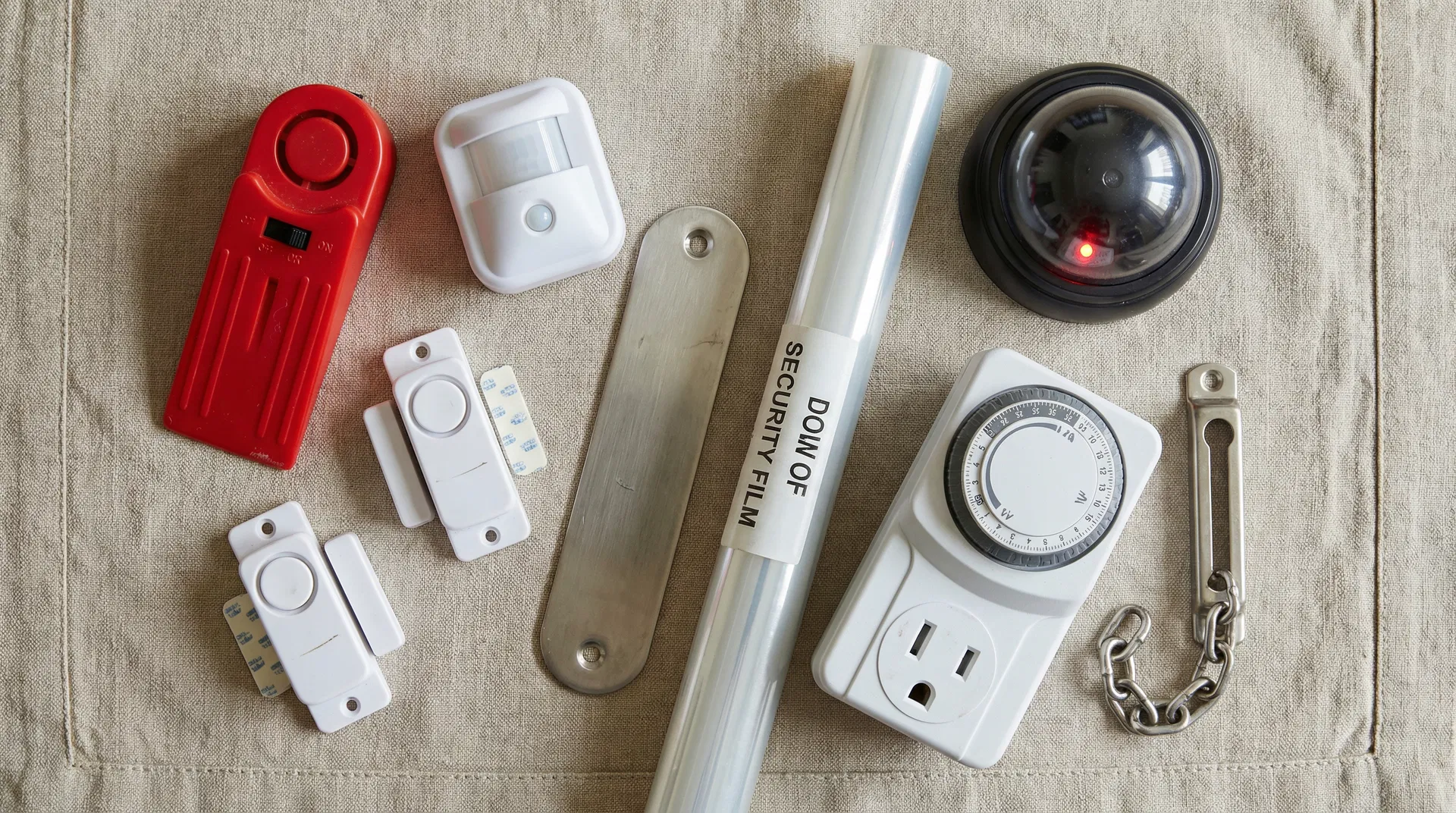
**Professional security systems cost $500-2000, but burglars avoid homes with visible deterrents regardless of price.** These 10 items from the dollar store ($1-3 each) provide real security value. Criminals look for easy targets; these make your home look hard.
Dollar Store Security: 10 Items That Actually Work
Estimated read time: 8 minutes | Difficulty: Beginner | Total cost: $0-20
You don't need a $500 smart security system to protect your home. Walk into any dollar store with $20, and you can walk out with enough security gear to make your home a significantly harder target. While the security industry pushes expensive cameras and monitoring services, the reality is simpler: most burglars are opportunists looking for easy targets, and a few cheap deterrents are often enough to send them elsewhere.
I've spent years testing budget security solutions, and I've learned that effectiveness has nothing to do with price tags. A $1.25 door alarm works just as well as a $40 version, it makes noise when someone opens the door. That's it. The expensive one doesn't scream louder or call the police faster. After testing dozens of dollar store security items, I've identified the 10 that actually deliver results. Here's what works, what doesn't, and how to use each one strategically.
Why Dollar Store Security Works
The psychology of deterrence is straightforward: Burglars spend an average of 8-12 minutes inside a home. They want quick, quiet entry with minimal risk of detection. Every obstacle you add, even a cheap one, increases their risk and reduces your home's appeal as a target.
Law enforcement data consistently shows that visible security measures deter most break-ins before they happen. A study by the University of North Carolina found that 60% of burglars would avoid a home with visible security measures, even if those measures were basic or fake. Your goal isn't Fort Knox-level security, it's making your home less attractive than your neighbor's.
Dollar store items work because they address the fundamentals: noise (alarms), visibility (lighting), and physical barriers (locks, reinforcements). These aren't sophisticated solutions, but sophistication isn't what stops burglars. Friction is.
The 10 Items That Actually Work
1. Motion-Activated LED Lights ($1-$1.25)
What they are: Battery-powered LED lights with motion sensors, typically designed for closets or hallways.
How to use them for security: Mount these inside near windows and doors. When someone opens a window or door, the sudden light creates the impression someone is home and aware of the intrusion. Place one above your front door (inside) so it lights up when the door opens, burglars hate unexpected light.
Pro tip: Put one in your garage near the door to your house. If someone breaks into your garage, the light alerts you before they reach your living space.
Effectiveness rating: 8/10 for interior deterrence
2. Door and Window Alarms ($1.25)
What they are: Simple two-piece magnetic alarms that emit a loud beep (85-95 decibels) when the magnetic contact is broken.
How to use them for security: Install on all ground-floor windows and any doors you don't use daily. The key is placement, put them where an intruder would enter, not where you enter. Many people waste these on their front door, which they open 10 times a day. Put them on basement windows, side doors, and garage windows instead.
Pro tip: Buy 10-15 of these and use them liberally. At $1.25 each, there's no reason not to cover every vulnerable entry point. The noise alone will send most intruders running.
Effectiveness rating: 9/10 for entry-point protection
3. Reflective Address Numbers ($1)
What they are: Stick-on reflective numbers for your mailbox or house.
How to use them for security: This seems counterintuitive, but visible address numbers are a security feature. Emergency responders need to find your house quickly if you call 911 during a break-in. More importantly, homes with clear, visible addresses look well-maintained and occupied, two things burglars avoid.
Pro tip: Place them where they're visible from the street at night. If your house number is hidden or faded, your home looks neglected, which attracts unwanted attention.
Effectiveness rating: 6/10 for deterrence, 10/10 for emergency response
4. Fake Security Camera Stickers ($1)
What they are: Adhesive stickers warning that premises are under video surveillance.
How to use them for security: Place these on windows near entry points, front door, back door, garage. The goal is to create doubt in a potential intruder's mind. Even if they suspect the sticker is fake, the uncertainty might be enough to move them along.
Reality check: These work best in combination with other visible security measures. A sticker alone won't fool anyone, but a sticker plus motion lights plus door alarms creates a layered impression of security.
Effectiveness rating: 5/10 alone, 7/10 as part of a layered approach
5. Dowel Rods or Wooden Sticks ($1)
What they are: Wooden dowels, curtain rods, or even broomstick handles cut to size.
How to use them for security: Place these in the track of sliding doors and windows. Even if someone defeats the lock, they can't slide the door or window open. This is one of the oldest and most effective security tricks, it's pure physics.
Pro tip: Cut the dowel so it fits snugly in the track with the door/window closed. For extra security, drill a small hole through the window frame and dowel, then insert a nail, this prevents someone from lifting the window out of its track.
Effectiveness rating: 10/10 for sliding door/window security
6. Personal Alarms ($1.25)
What they are: Keychain-sized alarms that emit a piercing 120+ decibel sound when activated.
How to use them for security: Attach these to doors using string or fishing line. When the door opens, the line pulls the pin and triggers the alarm. You can also keep one on your nightstand as a panic alarm if you hear someone breaking in.
Pro tip: These are loud enough to wake neighbors and scare intruders. Place them on doors you don't use often, basement doors, side entrances, shed doors.
Effectiveness rating: 8/10 for noise deterrence
7. Reflective Tape ($1)
What they are: Bright reflective tape used for safety marking.
How to use them for security: Apply this to the edges of steps, walkways, and dark corners around your property. Burglars rely on darkness and familiarity with your property layout. Reflective tape disrupts that by making obstacles visible and creating the impression that someone cares about the property.
Pro tip: Use this on fence gates, shed doors, and the edges of your driveway. It's subtle during the day but highly visible at night.
Effectiveness rating: 6/10 for deterrence through visibility
8. Cable Ties/Zip Ties ($1 for 50+)
What they are: Plastic cable ties in various sizes.
How to use them for security: Use these to secure gates, shed doors, and fence panels. While they can be cut, they create an additional barrier and make noise when tampered with. You can also use them to attach alarms to doors or to secure outdoor items (grills, bikes) to fixed objects.
Pro tip: Use brightly colored zip ties on gates and sheds, the visibility signals that someone is paying attention and will notice if they're cut.
Effectiveness rating: 7/10 for secondary barriers
9. Solar Garden Lights ($1.25)
What they are: Small solar-powered LED lights designed for garden paths.
How to use them for security: Line your walkways, driveway, and perimeter with these. Burglars prefer darkness, it provides cover and makes it easier to approach unnoticed. Solar lights eliminate that advantage without increasing your electric bill.
Pro tip: Place them near windows and entry points, not just on paths. The goal is to eliminate dark corners where someone could hide or work on a lock unnoticed.
Effectiveness rating: 7/10 for perimeter lighting
10. Small Mirrors ($1.25)
What they are: Handheld or wall-mounted mirrors.
How to use them for security: Mount these at corners or angles where you have blind spots, around the side of your house, near gates, or at the end of your driveway. This lets you check these areas without physically walking around corners, which is useful if you hear a noise at night.
Pro tip: Position a mirror so you can see your backyard from a front window, or vice versa. This gives you situational awareness without exposing yourself.
Effectiveness rating: 6/10 for situational awareness
How to Layer Your Dollar Store Security
The key to effective budget security is layering. No single $1 item will stop a determined intruder, but 10 items working together create friction, noise, and visibility, the three things burglars hate most.
Here's a complete $20 security system:
| Item | Quantity | Cost | Purpose |
|---|---|---|---|
| Door/window alarms | 10 | $12.50 | Entry point detection |
| Motion LED lights | 3 | $3.75 | Interior deterrence |
| Dowel rods | 2 | $2.00 | Sliding door/window barriers |
| Solar garden lights | 4 | $5.00 | Perimeter lighting |
| Personal alarm | 1 | $1.25 | Panic/door alarm |
| Total | 20 items | $24.50 | Layered security |
Installation priority:
- Start with alarms on all ground-floor windows and unused doors
- Add dowel rods to sliding doors and windows
- Install motion lights near main entry points
- Place solar lights to eliminate dark corners
- Keep a personal alarm accessible in your bedroom
What Dollar Store Security Can't Do
Be realistic about limitations. These items won't stop a determined, professional burglar with tools and time. But here's the reality: professional burglars are rare. Most break-ins are crimes of opportunity committed by amateurs looking for unlocked doors and easy targets.
Dollar store security won't provide:
- Video evidence for police
- Remote monitoring or alerts
- Protection against forced entry with tools
- Fire or carbon monoxide detection
What it will do:
- Make your home a harder target than your neighbors'
- Create noise that attracts attention
- Provide early warning of intrusion
- Deter opportunistic burglars
If you want more advanced security, use dollar store items as your foundation, then add one or two higher-quality components, a real camera for your front door, or a monitored alarm system. But start with the basics. A $20 investment in dollar store security is infinitely better than doing nothing because you can't afford a $500 system.
Installation Tips and Tricks
Test everything before installation. Dollar store items have variable quality, some door alarms are louder than others, some motion lights are more sensitive. Test each item before committing to placement.
Use strong adhesive. The adhesive that comes with dollar store items is often weak. Reinforce with stronger double-sided tape or small screws if possible.
Replace batteries proactively. Most of these items use watch batteries or AAAs. Check them every 3-6 months and replace before they die. A dead alarm is worse than no alarm, it creates false confidence.
Combine with free security measures. Dollar store items work best when combined with zero-cost strategies: locking doors and windows, trimming bushes near entry points, keeping valuables out of sight, and building relationships with neighbors who watch out for each other.
The Bottom Line
Security doesn't require a big budget, it requires a strategic mindset. For less than the cost of a pizza delivery, you can implement a layered security system that makes your home significantly less attractive to burglars. These items won't win any design awards, and they won't impress your friends, but they work.
The best security system is the one you actually implement. If a $500 smart camera system is keeping you from doing anything, you're less secure than someone who spent $20 at the dollar store and actually installed it. Start with what you can afford, layer your defenses, and remember: your goal isn't to be impenetrable, it's to be less appealing than the house next door.
Visit your local dollar store this week. Walk out with $20 worth of security items. Spend an hour installing them. You'll sleep better knowing you've taken practical, affordable steps to protect your home and family.
Have you used any dollar store items for home security? Share your experience in the comments below, your insights could help fellow readers stay safe on a budget.
No comments yet. Be the first to share your thoughts!
Related Articles

Secure your rental home without drilling holes or violating your lease. Budget-friendly security solutions for apartments.
Protect your empty home from burglars with these free and low-cost strategies. Most vacation break-ins succeed because of obvious mistakes that cost nothing to prevent.
Walk your property like a burglar would and identify vulnerabilities in 5 minutes. This free audit reveals weak points most homeowners miss.